Sparrow fledgling – identification, feeding and first aid step-by-step
I found a sparrow chick on the pavement – what now? This is a question many people ask themselves, especially between May and July when the sparrow breeding season is at its peak. Before you take any action, you need to know that not every young bird requires rescuing. This guide will take you through all the stages: from recognising the situation, through emergency feeding, to contacting professionals.
Key information in brief
If you're standing over a chick and need some quick advice, here are the key points:
Not every young sparrow needs help – The difference between a naked chick (requiring intervention) and a fledgling with feathers (often observation is enough) is crucial for the correct response.
Warm before feeding In the first few days of life, chicks lose heat rapidly and need warm shelter; you must ensure thermal stability before thinking about feeding.
Insect-based diet – the base is soft insects, earthworms, and larvae; bread, milk, and raw grain are dangerous for sparrow chicks and can kill them.
Observe before acting – Observe from hiding for 20-30 minutes to see if the adult birds return to feed the young.
Seek help – If in doubt, contact your local wildlife rehabilitation centre or consult a veterinarian as soon as possible.
How to recognise a sparrow fledgling and when it truly needs help?
A typical situation looks like this: a May or June morning, you're walking along the pavement and suddenly you see a tiny, helpless creature under the window of a tenement building. Sparrow nests in building crevices, under roofs, or in nesting boxes can fall out due to storms, predator attacks, or renovations.
The appearance of a typical sparrow chick
Identifying young birds of this species is not difficult:
Naked chick (1-5 days old) pink body covered in fine down, closed eyes, completely helpless
Chicks of sparrows have very large beaks with bright yellow corners, which help parents get the food right
Partially feathered (5-12 days) – eyes open, visible feathers, but not yet fully developed; sparrow chicks are covered in feathers after about two weeks
Inability to thermoregulate – naked little chicks cannot maintain their body heat
Chick or fledgeling – the key difference
Chicks become fledglings after about two weeks, leaving the nest even though they cannot yet fly well. This is a natural stage of development. Sparrow fledglings are very sociable and noisy – they hop, peep, and actively react to their surroundings.
Feature
Chick
Woodlouse
Feathers
None or minimal
Full plumage
Eyes
Closed or newly opened
Fully open
Reaction
It lies there limply, trembling
Unique touch, it bounces
Parents
Feeding in the nest
They feed from a distance
When to observe, when to act?
Chicks of sparrows that have left the nest may be cared for by their parents, who continue to feed them and teach them independence, so they do not always require human intervention. Observe from cover for 20-30 minutes to see if adult sparrows return – look for birds carrying insects in their beaks.
Intervene immediately when:
The chick is chilled (cold to the touch, apathetic)
Wounds or blood are visible
There are cats or dogs nearby
A bird lies on a busy street
The parents haven't shown up for over an hour
Intervention is necessary when a chick is unfledged, unable to move or fly, meaning it requires immediate assistance.
Important: The myth of parents rejecting their young because of human scent is completely false. Birds do not rely on smell – their parental instinct is based on the chick's sounds and visual cues.
The natural diet of a sparrow chick in the nest
Before you start feeding a baby sparrow at home, you need to understand what it eats in the wild. This knowledge will help you choose the right diet and avoid serious health problems.
How parents feed their offspring
Adult birds, despite their granivorous lifestyle, switch to insectivory during the breeding season. They collect aphids, small caterpillars, spiders, midges and larvae in meadows, lawns and gardens. In the first weeks of their lives, sparrow chicks are fed almost exclusively on animal matter, mainly insects such as aphids, caterpillars and spiders, which provide the essential protein for their growth.
Protein accounts for 70–90% of the nutritional value during the first 10 days of life. This is crucial for the development of muscles, bones and feathers. Parents feed their chicks up to several dozen times an hour – under favourable conditions, this can amount to 50–100 returns to the nest per day.
When do the seeds appear
Seeds They are only introduced after 10–12 days of age. Before this, the digestive tract of young chicks is not adapted to digesting solid food. A protein deficiency in the first few weeks causes rickets, weakness and mortality rates of up to 80% in poor breeding seasons.
Emergency Feeding of a Sparrow Chick at Home – What and How to Feed It?
This section is for situations where there is no realistic chance of returning a chick to its nest or getting it quickly to a rescue centre. What should chicks be fed in these circumstances?
First rule: heat first
The optimal temperature for sparrow chicks in the first weeks of life should be between 30 and 35°C to prevent chilling. Never feed a chilled bird – its body is unable to digest food.
How to warm a chick:
Hot water bottle wrapped in a towel (change every 2-3 hours)
Hot water bottle (37°C)
Heating mat under half of the box
A heat lamp at a safe distance (20 cm)
After 15-30 minutes of thermal stabilisation, you can proceed with feeding.
Safe products for chicks
Sparrow chicks require a diet rich in soft insects, earthworms, and larvae, which are easily digestible and provide protein and other key nutrients in their first few weeks of life.
Recommended foods
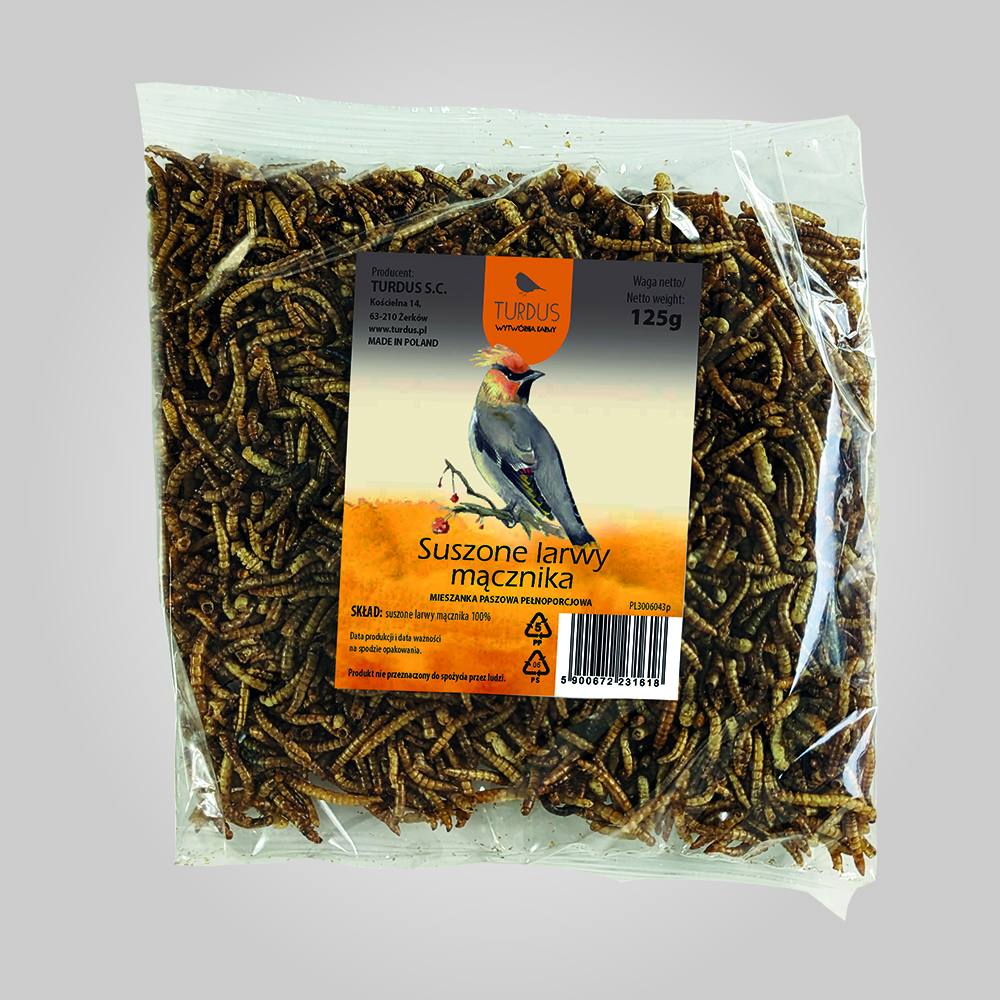
Mealworm larvae (available in our shop – minced for the youngest)
Maggot larvae from cultivation (so-called white worms)
Small feeder crickets without hard legs
Earthworms – cut into small pieces
In an emergency: lean poultry meat, cooked without seasoning (max 10% of the diet)
In the diet of sparrow chicks, earthworms and larvae, such as mealworms, are important sources of protein that support their growth and energy.
Add a little boiled water to achieve a yoghurt-like consistency
Serve food rich in protein lukewarm (35-37°C).
For older chicks (6-12 days):
Whole insects 3-5 mm without hard parts
Less water in the pulp
You can feed the larvae whole
Rescue blend for the first few hours
If you don't have access to feeder insects:
1 part low-fat cottage cheese (source of calcium)
1/4 of a boiled egg yolk (vitamins)
1/2 part crushed insects or meat
Please note: This is only a solution for the first few hours. The lack of a complete nutritional profile causes diarrhoea after 24-48 hours.
Nie należy podawać pisklęciu wróbla chleba, mleka, soczystych owoców ani niczego słodkiego.
Many human food products may seem suitable, but they are dangerous for chicks. Statistics from rehabilitation centres show that 60% fatal mistakes are caused by an inappropriate diet in the first 24 hours.
List of prohibited foods
Chicks should not be given bread, milk, meat, cold cuts, or dog/cat food.
Product
Why dangerous
Bread
Swells in the crop, blocks digestion (death in 12-24h)
Milk and dairy
Lactase deficiency, fermentation, diarrhoea
Raw grains, rice, groats
They damage the digestive tract
Salted nuts, cured meats
They damage the kidneys (hypernatraemia)
Too many fruits
They acidify the stomach
Avocado
Contains the toxin (persin)
Water – a hidden threat
Do not give water from a large syringe or bottle into the beak. This risks choking and pneumonia, which can kill a chick in 1-2 days. Young birds get most of their water from moist food. Water can be given drop by drop with a syringe or pipette, but only if there are clear signs of dehydration.
Regardless of the situation, do not experiment with human medications or vitamins. Paracetamol is toxic to a bird's liver.
Feeding techniques and frequency – from dawn till dusk
The feeding schedule depends on their age. We feed a naked chick differently from an active, feathered fledgling.
Approximate frequencies
In the first few weeks of life, chicks require regular feeding every 2-3 hours, which means intensive care. In more detail:
Days 1-5 of life: Every 20-40 minutes (80-120 portions per day)
6th-10th day: 45-60 minutes (50-70 portions)
Woodlice every 1.5-2 hours (20-30 portions)
Feeding takes place from early dawn (around 5-6 am) to dusk (9-10 pm in summer). At night, birds in the wild are not fed – the chick rests at a slightly lower temperature (around 25°C).
Correct technique
When feeding chicks, food should be given directly into their beaks:
Use fine tweezers (0.5-1 mm) or a taped toothpick
Gently touch the corner of the beak – the chick will open it by itself
Place the food into the throat at a 45° angle.
Wait to swallow before the next portion
Check the breast – if it is hard and engorged, skip feeding
Assess the situation before each instance. If the uterus is hard, contact a specialist.
Hygiene
Wash your hands before and after feeding.
Disinfect the 70% tools with alcohol
Remove food residue from feathers with a damp cotton bud.
Change the substrate every 2-4 hours
Living conditions for a sparrow chick at home – warmth, peace, safety
Even the best dietary solution won't help if the chick is in unsuitable conditions. You must ensure it has the right temperature, quietness, and safety for proper development.
Makeshift nest
Chicks should have access to suitable nesting materials and a space that provides them with comfort and safety:
Small cardboard box (15x15x10 cm) with ventilation holes
Lining with paper towels and a piece of soft cloth
No loose threads – risk of claws getting tangled
Line the bottom with soft material, creating a hollow
Temperature and humidity
Stage of development
Temperature
Heat source
Naked chick
30-34°C
Heating mat for the 50% box
Partially feathered
28-30°C
Hot water bottle every 3 hours
Woodlouse
25°C
Room temperature
The humidity in the environment around sparrow chicks should be maintained at 50–70%, which is crucial for their health. Dry air can dry out their airways.
Warning: Do not overheat the chick – temperatures above 35°C cause heatstroke.
A peaceful place
The box should be placed in a quiet location.
Away from the television and loud music
Without access for children and other pets
Without draughts
In partial shade (not full sun)
Noise raises cortisol levels, which inhibits growth and weakens immunity.
Health monitoring
Observe chick droppings as an indicator of its health:
Correct Green-white (white sediment is uric acid)
Alarm watery, yellow, or foul-smelling – a sign of infection or nutritional deficiencies
When domestic help is not enough – where to seek professional support?
Rearing a sparrow chick in a flat is very difficult. The mortality rate in home care without experience is as high as 50–80%, whilst in professional centres it falls to 20–40%.
Where can I find help in your area
If you are certain that a chick needs help, you can contact a bird sanctuary or a veterinarian for professional assistance:
Wildlife Rehabilitation Centres – e.g. in Bielsko-Biała, Warsaw
Albatros Foundation and similar organisations involved in bird protection
Veterinary practices cooperating with the local rehabilitation centre
Preparation for transport
A stable, small box of warmth
Noise and vibration control
Do not feed 1-2 hours before a long journey (risk of choking)
Don't open the box unnecessarily
Why is a specialist better?
Professional help means:
Incubators with precise temperature and humidity
Appropriate veterinary care (antibiotics if infection is present)
Correct „feralisation” – the bird does not get used to people
His chances of returning to his natural habitat are significantly increasing.
Within the first hour of finding the bird, call for advice. Even a short phone consultation can save the fledgling from nutritional mistakes and increase its chances of survival.
FAQ – Frequently Asked Questions about Sparrow Chicks
Is it possible to put a found sparrow chick back in its nest?
Yes – if you know where the nest is and can reach it safely, gently placing the chick back in the nest is the best course of action. The parents will not abandon their young because of the smell of humans. Birds recognise their parents by their calls, not by their smell. The risk of rejection is much lower than the risk of the chick being raised by someone without experience. In 80% cases, the adult birds return within 30 minutes.
How long can a sparrow chick survive without being fed?
Naked chicks require very frequent feeding, and even 2-4 hours without food when chilled can be critical (hypoglycaemia). With older fledglings, the safety margin is slightly larger (6-12 hours), but any help should be planned as soon as possible, ideally the same day. Don't delay – time is life.
Can a sparrow chick live in a canary or budgie cage?
A low box is better at the beginning, as it limits the risk of falls and injuries – a fall from a height of more than 20 cm can cause fractures. A typical tall cage is not suitable for naked chicks and young fledglings. A cage may only be useful in the final stage, when the bird is fully feathered, can move independently, and is learning to fly. Then, ensure safe equipment without bars that could cause entanglement.
When does a sparrow chick become independent?
Chicks leave the nest approximately 14-16 days after hatching, and their diet differs from that of adult birds. For the next 1-2 weeks, they remain under parental care as fledglings. Healthy development and full independence occur around 25-30 days of age. In domestic conditions, the bird should be released when it can confidently fly at least 50 metres, independently consumes a varied diet, and responds appropriately to environmental stimuli.
Is it allowed to keep a wild sparrow in the house permanently?
The house sparrow is a wild species protected under the Nature Conservation Act of 2004 (Art. 52). Its prolonged keeping without appropriate permits is generally prohibited in Poland, carrying a fine of up to PLN 5,000. The aim of any intervention should be the return of a healthy, fully functioning bird to the wild, preferably under the care of specialists from a rehabilitation centre. Permanent keeping deprives the bird of an independent life and the natural behaviours of bird species.
Remember: Finding a baby sparrow is a responsibility. Act quickly, but think it through. The general guidelines from this article will help you through the first critical hours, but professional assistance will always yield the best results. Save the number of your local wildlife rescue centre in your phone – it might come in handy not only for you but for anyone who encounters a bird in need of help.





 English
  Polish
  Russian