The breeding season of wild ducks: A complete guide to safe neighbouring

Key takeaways 

  • Duration: The breeding season for ducks in Poland runs from March to July (peak: April–May).
  • Socket locations: Not just on the water! Ducks nest in grasses, hedges, and even in balcony boxes.
  • The 5-metre rule: This is the minimum distance that allows the female to feel safe on the nest.
  • Legal aspect Mallard ducks are protected in Poland – the destruction of nests and disturbing the birds is punishable by law.

Where do ducks nest? Unusual nesting sites in cities

Many of us associate duck's nest with a clump of reeds by the lake shore. However, in the age of urbanisation, ducks (especially mallards) are increasingly choosing urban areas. Why? Because there are fewer natural predators in cities, such as foxes or goshawks.

Where can you find a duck's nest?

  • In dense hedgerows and domestic gardens: The duck is looking for shade and shelter from the wind.
  • Tree hollows Although it sounds exotic, ducks can nest high above the ground (e.g. goosanders).
  • On balconies and terraces: Flower beds with last year's vegetation are an ideal hiding place for a duck to lay its eggs.
Duck nest

Expert from Turdus.pl advises: If a duck has nested on your balcony, do not try to feed it directly at the nest. The smell of food will attract magpies and crows, which are just waiting to steal the eggs.

The breeding season for ducks proceeds step by step as follows: 1. **Courtship and Mate Selection:** During late winter and early spring, males engage in courtship displays to attract females. These displays vary by species but often involve head bobbing, wing flapping, and vocalizations. Females select a mate based on these displays. 2. **Pair Formation:** Once a pair is formed, they often stay together for the breeding season. The pair may reinforce their bond through mutual preening and communication. 3. **Nest Site Selection:** The female is primarily responsible for choosing a nesting site. She seeks out a safe location, often concealed by vegetation, near water. This could be on the ground, in a tree cavity, or even a man-made structure. Safety from predators is a key factor. 4. **Nest Construction:** The female builds the nest, typically a shallow depression lined with plant material like grass, reeds, and leaves. She may also line it with down feathers plucked from her own body, especially as she gets closer to laying eggs. This down helps insulate the eggs and conceal them when the female leaves the nest. 5. **Egg Laying (Ova-position):** The female lays her eggs, usually one per day, over a period of several days or weeks. The number of eggs varies significantly by species, ranging from a few to over a dozen. The eggs are typically smooth and oval, varying in colour from white to pale green or blue. 6. **Incubation:** Once the clutch is complete, the female (and sometimes, though less commonly, the male) begins incubating the eggs. Incubation involves sitting on the eggs to keep them warm and at a consistent temperature, crucial for embryo development. The female will leave the nest periodically to feed and drink. 7. **Hatching:** After the incubation period, which also varies by species (typically 21-35 days), the ducklings emerge from their shells. They are precocial, meaning they are relatively developed at birth and can walk, swim, and feed themselves shortly after hatching. 8. **Brood Rearing:** The female leads the newly hatched ducklings away from the nest to a suitable water source. She protects them from predators and guides them to food. The ducklings grow rapidly, and their downy feathers are gradually replaced by juvenile feathers. 9. **Fledging:** The ducklings, now called juveniles, develop flight feathers and learn to fly. This period, known as fledging, typically occurs several weeks after hatching. Once they can fly, they are increasingly independent. 10. **Dispersal and Independence:** Young ducks begin to disperse from their mother and establish their own territories or join other groups. They will continue to grow and mature until they are ready to breed themselves in a subsequent season.

Understanding the biology of these birds helps us to better respond to their presence in our environment.

  1. Choosing a location and building a nest: The female lines her nest in the ground with dry grass and her own down, which she plucks from her breast. It is this down that provides ideal thermal insulation.
  2. Egg laying: A duck usually lays between 8 and 13 eggs. It does this at one-day intervals.
  3. Incubation Takes about 28 days. Crucially, the female only begins incubating after the last egg is laid, meaning all ducklings They hatch at almost the same moment.
  4. Launch A few to a dozen hours after hatching, the mother leads the young to the water. This is the most dangerous moment of their lives.

Scenario: „I see a duck with ducklings in the middle of the road” – what to do?

This is a situation that evokes the most emotion. We often feel the urge to catch the ducklings in a box and take them to the pond. Warning: this is a last resort.

How to help safely?

  • Be a „human shield” If ducks are crossing the road, stand safely at the side and signal to drivers to slow down. Do not chase the ducks – a panicked mother may fly away, leaving her young to a certain death.
  • Remove obstacles Little ducklings can have trouble with high kerbs. You can lay down a board or gently help them over the architectural barrier, without touching them with bare hands (use gloves or a cloth to limit scent transfer).
  • When to call for help? If a family of ducks is trapped in a closed-off patio with no exit, or has fallen into an unsecured drain, call 986 (City Guard) or to a local wildlife rehabilitation centre.

Dlaczego etyka obserwacji jest kluczowa dla Turdus.pl?

At Turdus.pl we promote an approach based on respect for wildlife. Nesting season for ducks This is a time when these birds are extremely energetically exhausted. Any disturbance of the female from the nest is a loss of precious energy, which she may not have enough of to successfully complete the breeding.

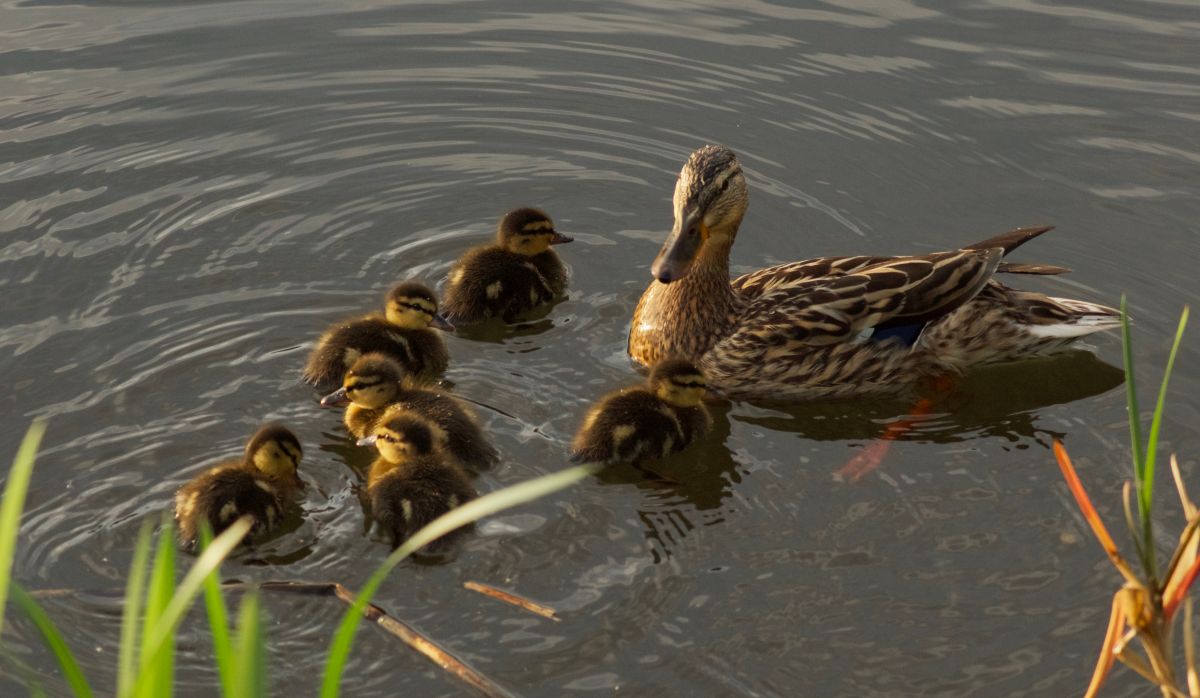
A mallard duck with her ducklings

Remember the golden rule of the observer:

„If a bird is looking at you and stops its natural activities (e.g. nest-building, resting), it means you are too close.”

Table: What is allowed and what is not allowed at the nest?

Situation / ActionIs it allowed?Detailed justification and instructions
Touching eggsAbsolutely notEggs have a porous structure. The transfer of bacteria or human scent can attract predators or cause the female to reject the brood.
Moving a socketNIEThe duck will not accept a nest moved even by a metre. This action almost always results in the death of the embryos.
Approaching a duckNO (keep min. 5m)The female on the nest employs a „freezing” strategy. If she flees, it means you have crossed her critical threshold and risked chilling the brood.
Taking photos (selfies)NIEThe sudden appearance of a large silhouette over the nest is interpreted as a predator attack. Use only the telephoto lens from a distance.
Feeding at the nestNIELeftover food (grains, vegetables) attracts rats and magpies, which will also eat eggs or freshly hatched ducklings.
WateringYES (with head)You could place a shallow drinking spot (e.g. a plant pot saucer) 2-3 metres from the nest, so the duck can drink without having to travel far.
Assistance with „water baptism”ONLY WHERE THERE ARE BARRIERSOnly help if the ducklings cannot overcome a kerb, wall, or netting. Do not „force” them into water if the mother is going in a different direction.
Cleaning around the nestNIELeaves and twigs are natural camouflage. Your „tidying up” might expose the nest to predatory birds.

en_GBEnglish